
The ancient Greeks designed and built world class buildings like the Parthenon. They proved theorems in geometry, and used their knowledge of mathematics in architecture and warfare. They sculpted classical representations of their deities and themselves.
The Greeks created democracy, which flourished at the agora, a place for continual learning opportunities. They sailed ships and exported olive oil to earn currency. They designed and built the first ships with decks to export and import more goods per odyssey (voyage). They learned to improve the ratio between capital and labor to increase their productivity and create wealth.
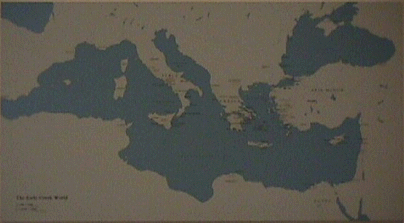
Through knowledge the ancient Greeks expanded their economy and influence throughout the region. They understood they could never have the standard of living they wanted if they attempted to live "off the land."
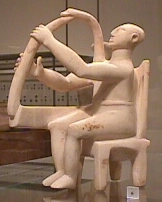
Theses Aegean (Greek) peoples sculpted in marble and played musical instruments. They built "open air" theatres with superb acoustics. They wrote and performed plays. The Greeks developed the art of comedy and tradgedy. They did these things because knowledge through learning was important to them. They sought answers to the following questions:
Knowledge work is planning, supervising, scheduling, and managing people, information systems, and customers. Skill is mental rather than manual. According to Thomas A. Stewart, "...We work with concepts, ideas, data, and information and develop services. Corporate management develops words like values, vision, empowerment, teamwork, facilitating, and coaching because they are searching for a language and a means for managing knowledge, knowledge work, and knowledge intensive companies." What type of legacy will we leave for future generations? Will we be as well respected and highly regarded 2,000 years from now as the classical Greeks are today? Does it what you learn? Does it matter what you do? Is what you produce a result of your ideas and practices?
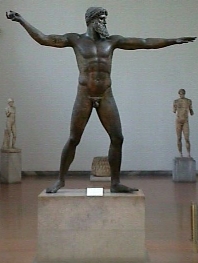
The sculptor captured the movement of the god Poseidon (of Artemision) in bronze. The Greeks enjoyed freedom of ideas and expression through democracy. Notice the freedom given to this diety by the empowered artist. The spread of the legs is counter balanced by the arms in this classical Greek masterpiece, ca. 4th century BC.
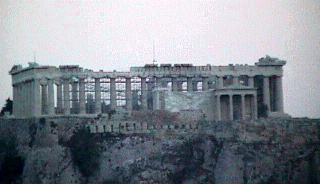
Pericles, the ruler of Athens commenced a major building program to demonstrate the power and culture of Athens. Pentelic marble was used to build the Parthenon. Construction commenced at the Acropolis in 447 BC. How did the Greeks manage to complete this major building by 438 BC? The architects used mathematics and geometry to design this classical masterpiece. How did they transfer their knowledge to the workers, who incorporated the required optical illusions into their building techniques?
Read the Main section of this work for an introduction to the problem area of the acquisition, retention, and transfer of knowledge.