The disclosure of the power
Using Macromedia Director to teach Lingo programming

Main Page
![[QFK Logo]](qfklogo.gif)
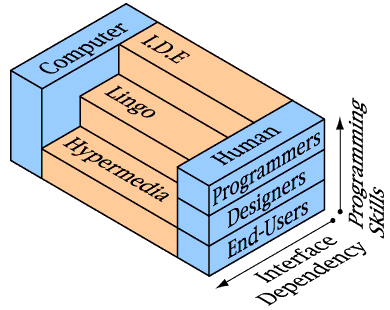
In short, the average end-user does not know much about how a computer works and, therefore, is highly dependent on the human-computer interface whereas a computer programmer is more familiar with computers and is, therefore, less dependent on the interface. This relative dependency is depicted in the following three dimensional model. At each step, the higher the hierarchy, the more programming skills people have. Relatively, the interface dependency or the width of the model is less than those of lower hierarchy.
The main aim of this article is to address the challenge of teaching multimedia designers to program in Lingo, Macromedia Director's programing language. Lingo enables multimedia designers to make their applications more interactive.
When teaching Lingo it is not enough to teach word by word interpretation of the language (imagine learning French using a dictionary). Most multimedia designers do not have previous programming experience and require a mediated environment (a sophisticated interface) to guide them through the initial stages of learning how to program a computer. So, multimedia designers require an interface that can help them reduce their interface dependency bringing them closer to a computer's inner workings. This ironic situation calls for an adaptive interface that gradually makes itself unnecessary. During my QFK trip to Greece several experiences gave me ideas about how to approach this interface challenge. These ideas are described in this article.
This article is divided into the following three pages.
| Ideas | Interfaces/Guides -- An adaptive interface that gives novice
programmers the best initial overview of computer programming and gradually
guides them through the domain.
Meta Cognitive Skills -- With the help of allegories students will learn how to identify and dig into problems and construct programs that address the problems in an effective and efficient way. |
| Practices | Interfaces/Guides -- Ancient Greeks used propylaea to give visitors
the best view of a sanctuary. Computer interface design can benefit from
the design considerations of propylaea. Tour guides quickly give visitors
a comprehensive overview of a complex civilization. A computer mediated
educational environment can benefit from such a guide.
Meta Cognitive Skills -- Archaeologists identify and dig into ancient sites and reconstruct the site from the ground up. These techniques of excavation and reconstruction are similar to the techniques of digging into a problem and constructing a computer program to address the problem. Allegories were used in ancient Greece to convey complex ideas. Allegories can be used to help novice programmers understand the complex domain of computer programming. Theaetetus is a good model of the practice of Cognitive Apprenticeship, it is also a good example of reasoning which can be used in search of truth. |
| Artifacts | Interfaces/Guides -- A description of the propylaea and tour
guides that we encountered on our travels.
Meta Cognitive Skills -- A description of the excavations that we encountered on our travels. Some of the allegories in ancient Greek literature and mythology. Possible outcomes -- What made our tour guides and ancient Greek propylaea so effective? Which characteristics of propylaea and tour guides can be translated to the computer interface of an educational environment? Which characteristics of archaeology can we translate into computer programming? |
Hon-Chih Chen was a graduate student in the Educational Communication and Technology Program at NYU.