
![[QFK Logo]](qfklogo.GIF)
"Whatever is appropriate to philosophy, also belongs to medicine: reserve, shame, calmness, patience, speaking of one's mind, frankness of speech, purity, knowledge of life's needs and difficulties, freedom form superstition and avarice knowledge of the supreme power of God" - Oath of Hypocrites (4 BC)
What were the ancient medical rituals related to making a diagnosis? Epidaurus became the healing center for the ancients. Here believers created outstanding architectural achievements. Here the theater is built into the slope of Mount Kynortion. The theater holds up to 15,000 people. Anyone can hear equally well from any seat. Even a whisper will rise from the stage to the top row of seats. As you may suspect, it remains a masterpiece of acoustics.
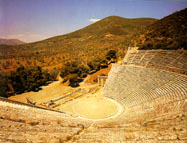
The suggestive power of the cult of Asklepios is difficult for us to understand with modern thought being as influenced by science as it is. Researchers believe that the cult followers used the space for a mass religious psychosis. When I stood in the semicircle of the theater I imagined how the mass of believers sitting in rows were induced into religious ecstasy under the rhythmic beat of holy chants.
The priest-physicians of Asklepios were never considered the least bit cheats or charlatans. They followed the traditional road of cultic therapy: compassion with no intent to create no harm. The difference between rich and poor patients became apparent only in the value of the patients' offerings (Asklepios preferred poultry as thanks). When Socrates emptied the poisoned cup (399 BC), he asked his disciple to sacrifice a rooster to Asklepios.
Certainly the general population in ancient Greece had medical access. But stelae inform us about the medical center admission policies. Simply put, those headed towards death were denied access. Birth and death were considered polluting and involving the powers over of life and death. This power was for the hands of the gods, not priests-physicians. Pregnant woman and the dying were therefore forbidden entry to the sanctuary.
Medical tools were uncovered at Epidaurus. In antiquity cesarean operations were only performed on mothers who had died. As a result, such operation rarely resulted with a living child. Otherwise, Greek physicians steered clear of surgery. They knew little of anatomy, lacked antiseptics, and hand no knowledge of the dangerous complications arising from war wounds.
In the earliest days of Greek medicine, physicians acted as healers and priests of the god Asklepios. Patient entered the early healing centers given the rites of incubation. In the temple room, patients would sleep with the aid of potions and slaves offered by physicians. Then all would wait for an accompanying dream to reveal the nature and cure of the illness.
This formulated my construct of medicine associate folk practices and spirituality. The construct involves patients obtaining improved health from a variety of nontraditional methodologies. Today these healers would neither belong to a popular cultural medical tradition nor a socially respected institution. The healers would exist on the fringes of medical practice. Here spirituality in a nontraditional sense or medical advice from a friend or writer of a self-help book might offer a patient diagnosis and plan freeing them from pain.
All this involves cultural beliefs and rituals. And in ancient times one entered the healing site before taking a purification bath. Spring water, a gift for the gods, was to entry rites and medical practice. Patients drank the holy water. Physicians used it in medicines, and for ablutions. Water symbolized a source of life. Epidaurus still has active springs.
Here I met two local women who still come to wash themselves aid in their ailments, arthritis and headaches. This is a good example of another of my cultural perspectives related to healing. The two women came to the springs thinking of a popularized belief in the healing power of the spring water. It is a tradition widely accepted and known by people living in the culture. The two woman were creating a self-diagnosis and treatment plan based in the culture's history.
The priest-physicians used medical programs well composed in psychological terms. Early on they heavily employed suggestion. They practiced hypnosis and lying on the hands. During the period of incubation, patients rested and went through periods of fasting. They rested until they hear sounds in the room. Gods' voices would direct the healing process. Ancient medical containers and vesicles offer the evidence that support the belief that sleep was induced and a hallucination was probable.
When it seemed that the god was approaching, the priest entered the room. Scented herbs (incense) were sprinkled onto red-hot coals. Then the priest-physician could use different therapies according to patient needs. Sometimes he administered an ointment on to the afflicted part of the patient's body. Or he would make an incision with a scalpel and close an open wound with a glowing iron. Then he may massage the wounded body part. Finally, he could summon the temple serpents to lick the eyelids and ears of patients were suffering from eye/ear complains. All of the healer's actions would come from the direction from the gods' voices expressed through the patient's hypnotic state.
How did Hypocrites influence medicine?
Ancient Greek physicians were called Asklepians (Hypocrites) and claimed direct descent from Asklepios himself. Hypocrites (470 -377 BC) was considered the eighteenth in succession to Asklepios.
Hippocratic medicine shifted medicine based on supernatural intervention with the conviction that illness was a consequence of nature and the patient. The theory shifted diagnosis from speculation to observation of symptoms. But culture affected the physician's diagnosis. They applied their gaze and knowledge with other natural phenomena. Their look also involved observing the cosmic constellations. It took into account environmental conditions, individual constitution, psychosomatic factors and the of body juices. The four body juices related directly to the four elements: cold to slime, warm to blood, dry to yellow gall, and humid to black gall. All of these were considered a part of the diagnostic process. All effected the physician's diagnosis.
In short, medical impressions started with a cultural perspective based on patient findings. Then the physician went to nature to look for further insight. The locus of a diagnosis was observation. This art involved logic, whose object is dependent on empirical evidence. The outcome developed into the three elements of physician's gaze we know today:
Herbal medicine also relieved human suffering. Certainly the early body of herb-lore associated with cult practices. In fact, Dioscurides created one of the first pharmaceutical guides. Only a small percentage of his hundreds of herbs have the activities he ascribe to them. Yet, this list remained active for centuries. It went on and generated the ancient herbal remedies used in medieval and some modern pharmacopoeias.
Hypocrites separated religion from medicine around the fourth century BC. Greek medicine became freer from cult practices and beliefs. This offered medicine the first set of principles from which our body of medical science became deductively derived.
This caused a divide in medical practice that lasts today. Patients viewed two perspectives: Physicians were said to have exaggerated their authority forgetting the (Asklepieion) holistic practices. Or patients' believed that a logical pattern in nature was the primary cause of their distress.
Thus the conflict of physicians making a diagnosis based on philosophy or science emerged. Similar questions exist today with Eastern versus Western medicine. Patients still question the physician's diagnostic approach and medical protocol.
How has today's culture effected the interpretation of Hippocratic Oath?
The original oath established the moral standards for physician practices. This includes the well-known counsel to create no harm to the patient. I uncovered a survey by Robert Orr, MD, and Norman Pang, MD of the University of Chicago. Their research states that 98 percent of all medical schools in the US and Canada administered the oath in 1993, compared to only 26 percent of the schools in 1928. Though the oath has not been a long-standing tradition, but is growing cultural tradition.
Also, not all medical schools use the same oath. It seems that there's been a steady decrease of some of the items found in the classical script, according to Christopher Tedeschi's report in University of Southern California's Health Magazine. It seems that only 11 percent reference "the other gods and goddesses." as part of the oath. Medical educators and students don't see a need to refer to god.
While only 8 percent use the line "I will maintain the utmost respect for human life from the time of conception." Some medical practitioners see this in conflict with issues surrounding abortion. Cultural influences originating with the Cult of Asklepios extend their influence, practices and morals involved in the practice medicine today.