
![[QFK Logo]](qfklogo.GIF)
"Knowing how to instill love and harmony in these hostile elements in the body, our ancestor Asklepios established this art of ours." - Plato's Symposium
What does the Asklepieion staff symbolize? The primary symbol of Asklepios as a healer involves his relationship with a snake and his staff. Cult followers viewed snake worship symbolically with a power of life and death. In ancient times the reptile's shedding of its skin symbolized rebirth. It also signified a shedding similar to the body's regeneration after illness, and so became a symbol of medical cures. The snake wraps itself around Asklepios' staff. The ancients used this symbol to connect the supernatural power of the god and his relationship with the serpent.
Modern interpretations view the staff as symbol of fertility and power. And like the antients, it's symbolized a spirit who holds the power between life and death. Some view his rod as a walking stick. (Asklepios and his disciples were always walking.) Medicine still uses this rich historical symbol today. Physicians still use the staff (caduceus) and snake as their public icon indicating the presence of a doctor. It also remains as an Asklepieion symbol of a distinguished humanitarian.
Archaeology provides evidence of more than 30 sanctuaries of Asklepios in the Mediterranean region. Patients at temples received medical treatment using hydrotherapy. Physicians used it for the treatment of eczema, rheumatism, gout, and psychosomatic disorders. This same practice related to these ailments still exists today.
This provides an example of another of my cultural based constructs relating to medical practices: knowledge based in a scientific approach of the prevailing culture. It illustrates the patient acquiring knowledge from specialized medical practitioner. Then following the physician's diagnosis and medical treatment plan.
What are votives?
Patients expressing their thankfulness created votives. These clay models of body parts, or stela, represented the patient's thankfulness to the god for treatment and cure. Some patients eagerly described the detail of their miraculous recovery. These anatomical bits and pieces described their case histories.
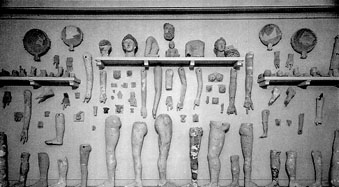
Inscriptions on the stelae tell of the patients' arrival, incubation, dreams, communication with the gods or the snake, and their recovery at the medical center.
What do votives medically reveal?
These votives offer insight into the beliefs and practices of ancient medical concerns. They also suggest therapeutic efforts. Patient votives involve ear/eye troubles, depression, reproduction, and limb mobility complaints. They left their votives near to the area were animal sacrifices for Asklepios took place.
Certainly male and female sterility and breasts were among the largest treatments requested. Hippocratic priests/physicians were aware of several types breast disease. The Greek physician Soranos (110 AD) distinguished between various hardening of the breast. Hydrotherapy was and is still used today for some medical conditions. Though most votives do not contain enough color to specify the illness. Many votives indicate blindness or other eye diseases were the other most often treated complaints.
One votive describes an example: Ambrosia from Athens was blind of one eye. She came to the god. Going around the shrine she mocked cures as incredible and impossible. She laughed at how the lame and blind became well by having a dream. But when she slept in the Shrine of the Dead, the god stood over her. He promised to cure her. But he required Ambrosia to give the temple a silver pig as a memorial of her lack of faith. Saying this, he cuts open her diseased eye and poured in a mixture. When the morning arrived she went away cured.
Clinical practices: Hypocrites brought about the concept of clinical medicine. And the medical site at Epidaurus represented the philosophy of medical clinics today. The clinic was a place that allowed for constant gazing upon the patient. The careful observer watching for connections between multiple patients complaints and a common thread related to medical issue.
This approach offered new speculation regarding the transformation of god related illness and treatment plan based in the natural science. The physician's watchful gaze over the patients emerging and changing over time still exists today. Physicians still use this clinical model in treatment plans. Even with slight modifications in the Hippocratic Oath, a physician's intent still remains to do no harm to the patient.