
![[QFK Logo]](qfklogo.GIF)
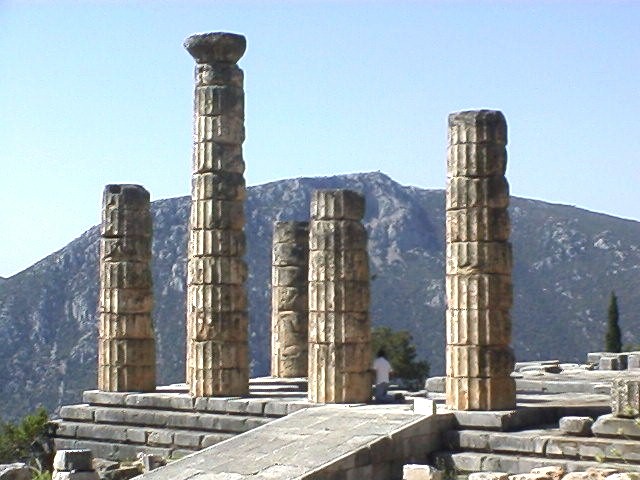
The fact that both of these gods were worshipped gives us some insight to the Greek culture, both ancient and contemporary. Different festivals took place in Delphi, each with different rituals dedicated to the two gods. Two of the more commonly known festivals in dedication to Apollo were the Panhellenic festival where the Pythian Games took place and the Septeria festival which was known as the feast of the purification. The Great Dionysia and the Lesser Dionysia were festivals dedicated to Dionysus, as well as the Lenea (a symbolic thanksgiving for the first wine of the season) and Anthesteria (the feast of the flowers). The festivals dedicated to Dionysus were quite different than to any other gods; given the nature of the worship. The celebrants in procession during the Great Dionysia held mock phalluses, which was a commemoration of the introduction of the cult of Dionysus Eleuthereus. In the Lesser Dionysia there were banquets, contests for ordinary people, and also processions. In all of Dionysiac festivals there would be drinking and dancing, as well as theatrical performances.
"Through drunkenness and ecstatic dance Dionysus offered mankind a feeling of boundless freedom which released them from their everyday worries. For that reason, he was known as Lysius (that liberates us from our troubles) and Catharsis (that cleanses our souls)." Greek Mythology and Religion, HA'I'TALIS, 1997, p.107.
The ancient Greeks allowed themselves to treasure both the good and the bad aspects of society. They did not find dancing and drinking to be an immoral part of society, but one that went along with worship. In Delphi today there stands discos and tavernas dedicated to just this type of social interaction. A club called Katuna piles in hundreds of tourists nightly during the summer and even more Greeks during the winter. Similar to the festivals of Dionysus, people meet and become immersed in a frenzied dance. Traditional Greek music is played and people hold each other in the steps of these ancient rituals. As Americans, we may go into this society that has a love of all aspects of life and not understand the ability of these people to become so immersed in what may seem to be immoral. This may stem from the fact that these traditions in Greek society are pre-Christianity. Oftentimes when wandering down the street in Greece Americans run into postcards and various objects that contain the images of the fertility gods. Instead of understanding the meaning behind the images, some tend to get the impression that the Greeks are engrossed in sexual genres. The only way to understand these images is to research the country and develop theses based on other people's knowledge. Through a deeper understanding of social roles common stereotypes may be either validated to a certain degree, or completely thrown out due to its inconsistencies.
Other comparisons of modern and ancient Greek gods and spirituality:
Modern: god is just, god is perfect, and humans are very important to god but god does not need humans to survive, written text, individual's beliefs are important.
Ancient: gods sought power, gods had flaws, humans are less important to the gods (power is more important) yet gods need humans to survive, oral tradition (no written text), communal worship was important (belief was not an issue).
Americans often run into these images of ancient fertility gods and are surprised by the comfort and candor with which Greeks view sexuality and the human body. This is because American culture is traditionally known as being sexually repressive. Americans (and many other Western cultures) are taught to be ashamed of their bodies and sexuality. Take a look at any Greek beach and you will see the difference between Americans and Greeks. In general Greeks are less concerned with body image and more concerned with enjoying themselves.
"Although it seems that Americans are open to culture, they are actually engrossed in their own." Tom Karabelussis, bartender at Katuna, Delphi, July 5, 1998
1. Getting there is the easy part.
2. Going with a group, finding a guide or buying a travel book are easy, but they have advantages and disadvantages. In a group you can see a different culture from relative safety but you can only get a limited understanding because you are stuck in a group pattern (you are not stuck in a culture's patterns).
Many times people travel in packs and they do not allow themselves to let go of each other and explore for themselves. They look to each other for guidelines on the appropriateness of their actions. Yet these set standards can actually hinder the learning process of going to a foreign country. Often it is fear of the unknown that causes people to act as a group consensus. This fear may be lost if a person within a country has the ability to point out to tourists the places to go and the significance behind these places. This is where a tour guide plays an important role.
A guide is useful for introducing you to different parts of a culture, but you are dependent on this person's viewpoint. Oftentimes guides give textbook experiences due to the nature of their job. Guides usually are talking to groups, which call for a concise and general information platform. Not all people like the same things, so it is impossible for a guide to explain all information that is useful to the individual. Also guides are often only knowledgeable in the highly touristed places. These types of experiences in foreign lands can often amount to a been there done that attitude. It is possible to have a guide that does not tour in this manner, especially if that guide is none other than yourself.
Guidebooks come in handy when learning about a particular place. Maps, places to go, and general comments about the society generally come in guidebooks. Each book is geared to different travelers; for instance, there are budget guides, guides for singles, for gays and lesbians, for the educated, for the partier. These books can slant your journeying experience by holding one place more favorable to the other, thereby inciting you to choose a place based on the author's opinions.
So far we know that guides, guide books, and our own culture's general opinion about a place may shape our decision about whether or not to travel to certain areas.

3. It is possible to explore areas on your own and learn about places by yourself. Although it is useful to be introduced to a culture by a guru, guide, or guide book, it is more important for a person to look to themselves as the decision maker if he/she wants to have a travelling experience as a process of self-discovery.
By becoming immersed in another culture you become open to new experiences which can be drawn upon by seeing things through a different angle. This forces a person to interact with an unknown reality. Traveling by yourself makes you integrate what you see within yourself, and the more this is done the more association with other cultures takes place. The world gets a little smaller and you can have a greater understanding of the wide spectrum of individuals within each culture. Sometimes traveling alone can be lonesome or difficult, but that is what makes it a rich experience.
"Good to travel alone, I think, opens you up to experience, opportunity and random beauty. Traveling partners, especially from your own culture, tend to divorce you from the necessity of having to throw yourself in new dimensions that face you without reference points of the known. Travel is not always a happy, upbeat experience; it can be a very difficult thing -that is what makes it rich. Don't search for ease." Rohan Fisher, Satellite Land Imager, received in Mykonos, Greece from Alice Springs, Australia through e-mail.
4. It is possible to let others join in on your transformational travel experience without actually ever setting foot outside their house. This is through the transmission of writing. It is through writing that others have a chance to share a travel experience. The descriptions, the realizations discovered through the writer, the sensations evoked by the surroundings; these are all the areas written about in travel journals. A person that keeps a journal not only is able to let others in on their experience by writing an account of what was seen while traveling, but is able to learn a great deal about themselves.
When keeping a travel journal it is not important to worry about how you are writing, but what you are thinking as you are writing it. By writing down the thoughts that encompass you as you live out your travel experience, you can learn a great deal about yourself. How you felt, how you reacted- these are things that are not easy to remember, nor are they easy to recreate. These emotions are what draws people, it makes them interested in what will happen next. Then, when reflecting upon these emotions, experiences, surroundings, and interactions, both the writer and the reader expand their mind and have a learning experience.
5. One of the many subjects that appear in travel journals is the experiences and conversations that people have with others while traveling. It is very important to be open to different cultures in your travels. This social interaction is integral to the overall transformational traveling experience. People from other cultures often have new and interesting perspectives. By talking with other travelers and also natives, you can have a broader travel experience.
Nowadays, travelers often meet in hotels where they have time to rest and reflect upon newly found experiences. As they reflect they will talk about their experiences, and are sure to discover others who have been to the same places. People will discuss new perceptions of the same place, and will bring up places that may be unknown to others. There begins a process of influence and a meeting of the minds takes place. As society is soaked in you make connections with other travelers and they enrich you and become a part of you. These people are as much a part of your travel experience as the places you visit.
The ancient Greeks had a meeting place that they called an agora. The root word means to collect or gather together. It was essentially a marketplace where people (men) met to buy the necessary items for their households and also to discuss their lives and the general purpose of them. Many travelers passed through the agoras, interacting with the people they found there. Through the midst of their travels they encountered many people who were stationary and had no influence of outside cultures. The travelers brought new cultural ideas to them, and the people, in turn, brought the travelers a new perspective of community life.
This way of socially interacting is difficult to achieve these days because there is a lack of community space. By not having public space, a person is not as challenged to rethink the places visited, therefore will mark the place off as "been there" rather than understanding the surroundings from different perspectives. Travelers do not have a place to meet with other travelers and natives on a community level. The agoras, the parthenons, the town halls, these community places are ceasing to exist. Today travelers meet at hotels, more specifically hotel bars and restaurants, where the person in the next room is the traveler and the bartender is the native. The bartender, and all the workers at the hotel tell the traveler about the area, and the tourist tells them the similarities and differences of "back home." The travelers do not need to hide the fact that they are tourists and ask questions at ease, while the workers give their honest impression of a place, which can often be different than a brochure aimed at a tourist.
By these types of social interactions both at the agora and at the hotel, a type of communal learning takes place. People ask questions about other lands, visiting them through the travelers experience, natives foster the talk, and a learning environment is created that is not a school, but is similar in ways of education. But the type of experience brought out in both agoras and hotels is also very individual. People become self-reflective, and are more apt to learn about themselves by their conversations with other people. This self-reflection can be enhanced by writing, and brought to many more people for their own personal and public growth.